SaralPHP - Building a Custom PHP MVC Framework From Scratch
Building a Custom PHP MVC Framework From Scratch
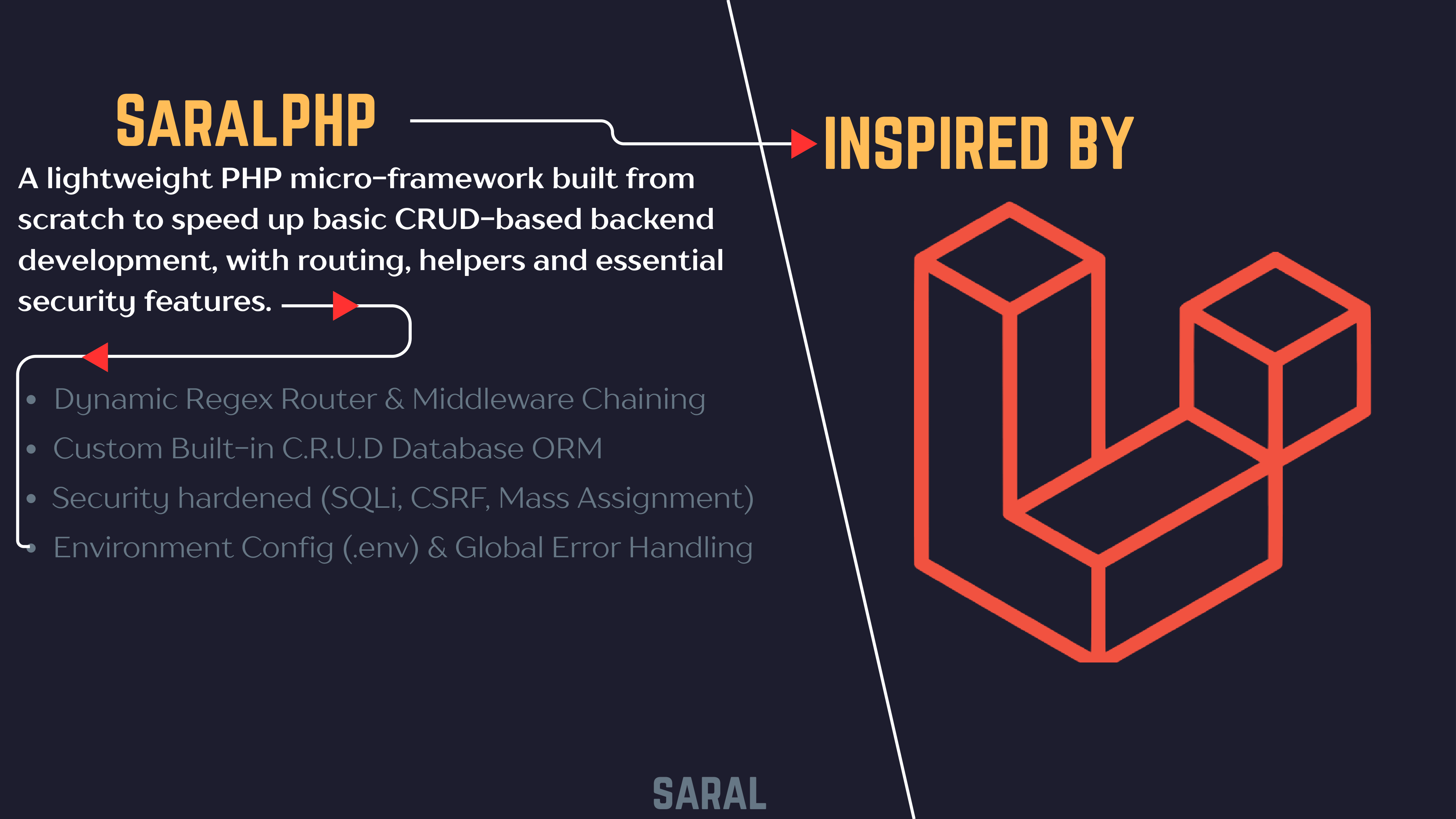
Hey guys! My name is Saral Singh, and today I want to take you under the hood of a project I recently finished building: SaralPHP.
As a backend developer, it is incredibly easy to rely on massive frameworks like Laravel or Symfony. You type php artisan make:controller, magic happens, and you move on. But I wanted to understand the magic. I wanted to know exactly how routing engines parse URLs, how middleware pipelines chain together, and how an ORM securely binds data to a database.
So, I built my own.
In this post, I am going to break down the core components of my custom PHP mini-framework, how it handles basic security, and why building your own MVC is one of the best learning exercises you can do.
Part 1: The Architecture & Autoloading
Before writing any logic, I needed a structure. I modeled SaralPHP after the industry standard: the Model-View-Controller (MVC) pattern.
app/Controllers/: Handles the business logic and HTTP responses.app/Models/: Interacts with the database.views/: Contains the frontend HTML/PHP templates.
To glue everything together without writing a bunch of require_once statements, I utilized Composer and PSR-4 Autoloading. By mapping the App\ namespace to my app/ directory in composer.json, PHP automatically finds and loads my classes the exact moment I instantiate them.
Part 2: The Router (Dynamic Parameters)
The heart of any framework is the Router. It dictates where a user’s web request should go.
Initially, I built a router that used strict string matching (if ($uri === '/login')). But real-world applications need dynamic URLs, like /user/5.
To solve this, I upgraded the router to use Regular Expressions (preg_match).
When you define a route in SaralPHP:
Route::get('/user/{id}', 'UserController', 'show');
The router dynamically converts {id} into a Regex capture group ([a-zA-Z0-9_-]+). When a user visits /user/25, the router extracts the 25 and passes it directly into the Controller method as an argument!
Part 3: The Middleware Resolver (Chaining)
Middleware acts as a bouncer for your routes. If someone tries to visit a protected page without being logged in, the middleware kicks them out.
Instead of hardcoding if statements into every controller, I built a MiddlewareResolver.
The cool part here is the ability to chain them using the pipe | operator in the routes file:
Route::get('/admin', 'AdminController', 'index', 'auth|admin');
Behind the scenes, the framework runs an explode('|', $middleware) and loops through the array. First, it runs the AuthMiddleware to ensure the session exists. If they pass, it moves to the AdminMiddleware to check their role. If any middleware fails, the request is stopped.
Part 4: The Database Layer & Basic Security
My goal was to build a base ORM (baseModel) that allowed for standard C.R.U.D operations while maintaining good security practices.
SQL Injection Protection
You should never pass raw user strings into a database query. SaralPHP’s ORM utilizes PDO Prepared Statements. On top of that, when creating or updating records, the framework runs a validation against the column arrays to ensure users cannot inject SQL payloads into the database structure itself.
Mass Assignment Protection
In frameworks like Laravel, if you try to save a whole $_POST array, a malicious user could inject an admin=1 hidden field into the form and give themselves privileges.
I implemented a similar defense: The $fillable array.
class User extends baseModel {
    protected $fillable = ['name', 'email', 'password'];
}
If a user tries to pass an admin flag during registration, the baseModel automatically filters it out and drops it before the database query is built.
Session Protections
In my AuthMiddleware, just checking if $_SESSION['id'] exists isn’t always enough because session cookies can be stolen. To add a layer of defense, upon login, SaralPHP binds the user’s IP Address and User-Agent (Browser string) to the session. On every protected request, it validates those markers. If they suddenly change, the session is destroyed.
Conclusion
Building SaralPHP from scratch was an incredible learning experience. It stripped away the magic of large frameworks and forced me to engineer solutions to real routing and security problems.
Today, I have a quite good mini MVC framework that I can use for basic CRUD websites instead of dealing with the massive overhead of larger frameworks. It includes .env environment loading and global exception handling, so it’s quite handy for rapid development.
If you’re a student or developer looking to understand framework internals, or just want to explore the source code, you can check it out below!
🔗 View SaralPHP on GitHub
🌐 Live Demo
Keep building, keep learning!